MindScript

A programming language for semantic computation with oracles that let you call LLMs safely from real code.
© 2024–2026 Daios Technologies Ltd
Read the Docs: https://mindscript.daios.ai
Try in Browser: https://www.daios.ai/playground
Source code: https://github.com/daios-ai/msg
What is MindScript?
MindScript combines a small, practical scripting language with oracles: typed, schema-gated functions executed by an LLM. You write normal code for deterministic logic, and use oracles when the step is inherently semantic (extracting meaning, labeling, rewriting, summarizing, matching, etc.).
A tiny example
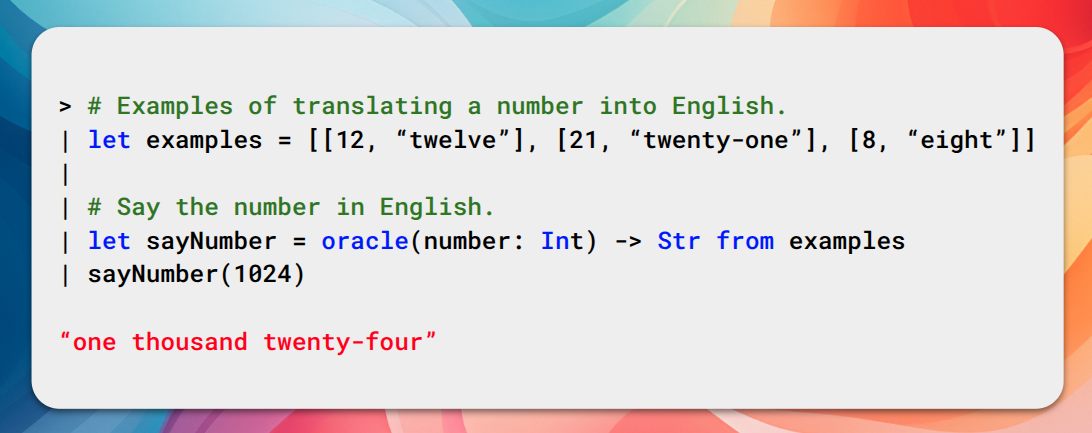
Define an oracle:
# Examples of translating a number into English.
let examples = [[12, "twelve"], [21, "twenty-one"], [8, "eight"]]

# Say the number in English.
let sayNumber = oracle(number: Int) -> Str from examples
Then, invoke it:
==> sayNumber(1024)
"one thousand twenty-four"
Oracles are typed: inputs and outputs are validated at runtime, so you can safely compose semantic steps with deterministic code.
Why you'd use it
- Semantic transforms as a first-class tool (not a bolted-on API call)
- Guardrails by default: runtime-checked types/schemas around LLM outputs
- Practical scripting workflow: run scripts and pipelines with the
msgruntime - Works great with JSON (for data interchange), but shines when the work is meaning
Applications
- Extract structured, typed JSON from messy text (emails, chats, notes), and use this to classify, label, and route items using their meaning
- Build semantic pipelines: map unstructured content into entities/relations, align to vocabularies, and emit JSON/linked-data shapes
- Build agentic applications that can reason and have autonomy
Installation
Download the installer and run it:
curl -fsSL https://raw.githubusercontent.com/daios-ai/msg/main/install.sh | bash~/.mindscript).
Once installed, you can execute the runtime by running the msg command:
$ msg
MindScript 0.1.4 (built 2025-12-16T13:12:08Z)

Usage:
  msg run <file.ms> [--] [args...]         Run a script.
  msg repl                                 Start the REPL.
  msg fmt [--check] [path ...]             Format MindScript file(s) by path prefix
  msg test [path] [-p] [-v] [-t <ms>]      Run tests (default root=".")
  msg get <module>@<version?>              Install a third-party module (not implemented)
  msg version                              Print the compiled version
For more installation options and configuring the LLM backend, check the Installation Guide.
Requirements
- Linux, macOS, or Raspberry OS.
- An LLM backend only if you run oracle calls.
Features
- LLM oracles as a language feature: declare LLM-backed oracle functions with typed inputs and validated JSON outputs.
- Multi-provider LLM support: supports Ollama, OpenAI (Chat Completions), OpenAI Responses, Anthropic, and Cohere backends.
- Comments as runtime data: comments attach as documentation and hints to oracle execution.
- Errors as values: No exceptions that hide execution flow.
- Dynamic, runtime-checked types: Function parameter and return types are enforced at runtime.
- First-class modules: imports modules from the local filesystem and from HTTP(S) URLs.
- Practical CLI tooling: the CLI provides script execution, an interactive REPL, formatting, and test discovery and execution.
- Batteries-included standard library: Includes iterators and functional helpers, JSON and schema bridges, filesystem and networking utilities, crypto, and process execution.
- Concurrency and communication primitives: Processes run in isolated interpreter instances that are scheduled like Go goroutines rather than an async/await model, with channels, timers, tickers, and actors for coordination.
- Metaprogramming: programs can be parsed into a canonical JSON-compatible S-expression form, transformed at runtime, and evaluated again via reification.
- Foreign function interface: on supported builds, loads native libraries and exposes functions, variables, and callbacks to extend MindScript with C APIs.
- Built-in testing framework: discovers test files, supports assertions and snapshot testing, runs tests in parallel, and reports failures with file and line locations.